yes

lub News
A sea of stars
Star party draws crowd to Wild Rivers Recreation Area
By Olivia Lewis
Apr 22, 2026
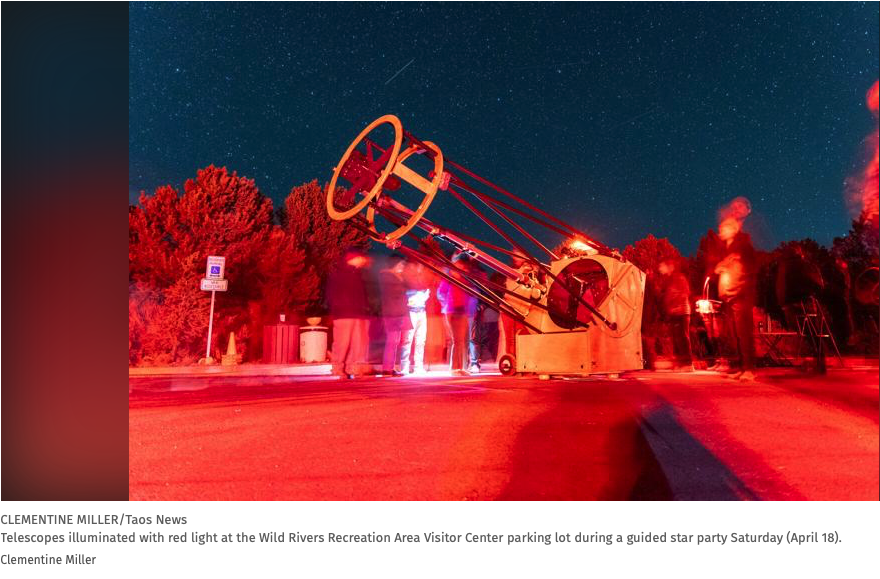
Under some of the darkest skies in New Mexico, over 50 night sky enthusiasts gathered at the Wild Rivers Recreation Area Visitor Center in the Rio Grande Del Norte National Monument for a stargazing party last Saturday (April 18) to celebrate Dark Sky Week.
The event, hosted by El Valle Astronomy Club and the Rio Grande del Norte National Monument, allowed residents and visitors views of the night sky that a minority of Americans see anymore — a dense sea of stars stretching from horizon to horizon.
With populations largely concentrated in urban areas across the U.S., even small burgs like Taos emit light pollution that obscures celestial bodies; even several miles from town, the faint glow of lights diminishes what one can see in the night sky.
“Doing this helps us protect our public lands in an ecological sense and a cultural sense,” said Lindi Smith, director of development for the nonprofit Friends of the Rio Grande del Norte National Monument. “Being able to support that feels really important to us. Our ecological landscape, the culture of the area, the history — it runs deep. I think protecting that and keeping away light pollution from this area is important.”
In 1999, New Mexico adopted the New Mexico Night Sky Protection Act, which regulates outdoor lighting to prevent light pollution, light trespass and glare. The law requires most outdoor light fixtures to be shielded or directed downward, while also placing restrictions on wattage and intensity. Exemptions exist for job safety and agriculture.
“Light pollution from the ground is a clear and present danger,” Derek Wallentinsen, chair of the New Mexico Dark Sky Places Committee, said during a live webinar at UNM-Taos’ astrophotography exhibition, Friday (April 17). “It’s growing by 10 percent a year worldwide.”
The International Dark Sky Association was founded in 1987 to stop the spread of light pollution. Later renamed Dark Sky International, the organization has certified over 250 Dark Sky Places worldwide.
That includes nine certified dark sky parks in New Mexico, which include: Clayton Lake State Park, Capulin Volcano, Fort Union National Monument, Salinas Pueblo, El Morro, Valle de Oro National Wildlife Refuge, Valles Caldera National Preserve, Chaco Culture National Historical Park and Cosmic Campground.
An effort to certify the Rio Grande del Norte National Monument is in progress. In recent years, advocates have also called on the Town of Taos and Taos County to update their dark sky ordinances, which were enacted in 2006 and 2007, respectively.
Advocates argue these ordinances should account for new lighting technology such as LED, which can emit light for greater distances and at more intensity, with increased effects on wildlife and human circadian rhythms.
“These [light] sources affect ecosystems, wildlife, human health, as well as astronomy and cultural aesthetics of the night sky,” Wallentinsen said.
‘Futureof amateurastronomy’
At one viewing station Saturday night, El Valle Astronomy Club member Gary Zientara demonstrated how guests could view thousands of galaxies, constellations and nebulae from a laptop connected to a smart telescope called the Seestar S30 Pro.
The telescope captures and layers images of the night sky in 20-second intervals, which produces vivid highly-detailed images of the Orion Nebula, Jupiter and other deep space objects. Zientara’s monthly “Galaxy Watch” column in the Taos News features images of galaxies and other deep space phenomena captured with his the Seestar S50 telescope at his observatory near Angel Fire.
“I think what’s pretty cool about this is that these galaxies are 60 to 80 million light years away, yet in just six minutes and 20 seconds of exposure, you can see all of them,” Zientara said, gesturing to the milky stardust of the Orion Nebula. “I think that is just unbelievable and that’s why this thing is designed the way it is. It’s designed to be very sensitive to dim light.”
“I really feel this is the future of amateur astronomy,” he said.
Thedustunderyourbed
At just 1,300 to 1,500 light years from Earth, the Orion Nebula is one of the closest star formations to Earth and is visible to the naked eye. The nebula is located in the Milky Way galaxy and is one of several “stars” that form the constellation of Orion, particularly Orion’s “sword.”
“The new stars are pushing the gas and dust away because they got hit with stellar winds,” Zientara said of the nebula. “They have radiation to light up the hydrogen in there and they also have stellar winds like our own Sun has. It starts blowing this fine dust.
“You might say, ‘Well, what kind of dust?’ The same stuff you find under your bed,” he said. “Small meteors come through our atmosphere, they vaporize and they form little, tiny clouds of dust that float down to the earth and eventually get under your bed.”
Visitors traveling between telescopes learned not just the science of the night sky, but its relationship to human history. Colin Nicholls, who teaches math, physics and astronomy at UNM-Taos, described how enslaved Africans living in the American South followed Polaris — the North Star — to freedom.
“We’re sort of fortunate that we have a star right above the axis of the Earth,” Nicholls said. “It makes for interesting pictures; but of course, this was what slaves would head for when they were trying to flee Confederate, slave-owning states back in the 19th century. They knew it [led] north toward abolitionist states.”
Astrotourism
The views exceeded the expectations of Sophia Williams, who lives in Colorado Springs.
“I didn’t expect them to have telescopes,” she said. “I thought we were just going to look up at the stars. We were talking to some locals in Taos and they were talking about what to do in the area.”
Taos County has good stargazing thanks to its low population density, high elevation and relatively little light pollution thanks to local Dark Sky ordinances. Much of Taos County falls on the darker end of the Bortle scale, a nine-level numeric scale measuring how much light pollution obscures the night sky.
Taos County generally falls between Class 3 to Class 4 on the Bortle Scale, described as “Rural” to “Rural/Suburban Transition” areas. Cerro, where the Wild Rivers Recreation Area is located, rates as Class 1 on the Bortle Scale — among the darkest skies on Earth.
Taos’ reputation as a stargazing destination is growing. In February, Home2Go, the world’s largest European vacation rental marketplace, released a study that ranked Taos third among the country’s top astrotourism destinations. The astrotourism report, which ranked Ruidoso fifth and Santa Fe 10th, scored locations based on accommodation, affordability and proximity to remarkable stargazing spots.
As the stars rotated across the sky Saturday, stargazers were reminded of their relatively minor place in the universe, an experience that’s more accessible far from city lights.
“I’m actually following NASA on Instagram and I’m very fascinated with everything up there — the imaging and colors,” Asiye McLean said. “When I was younger, I was sleeping on a rooftop in Turkey and was amazed by how many stars I could see. When I saw this [event], I said, ‘We have to do it.’”